 Sandustry Wiki
Lava Guide
Move heat into automation while keeping the process controlled.
Researched 14 Sep 2026 · Official facts separated from community observationsUpdate #3 (v0.5.6) made Lava denser and able to destroy several terrain materials. Update #4 (v0.5.7) fixes Lava leaking through Advanced Filter Walls.
Where Lava comes from
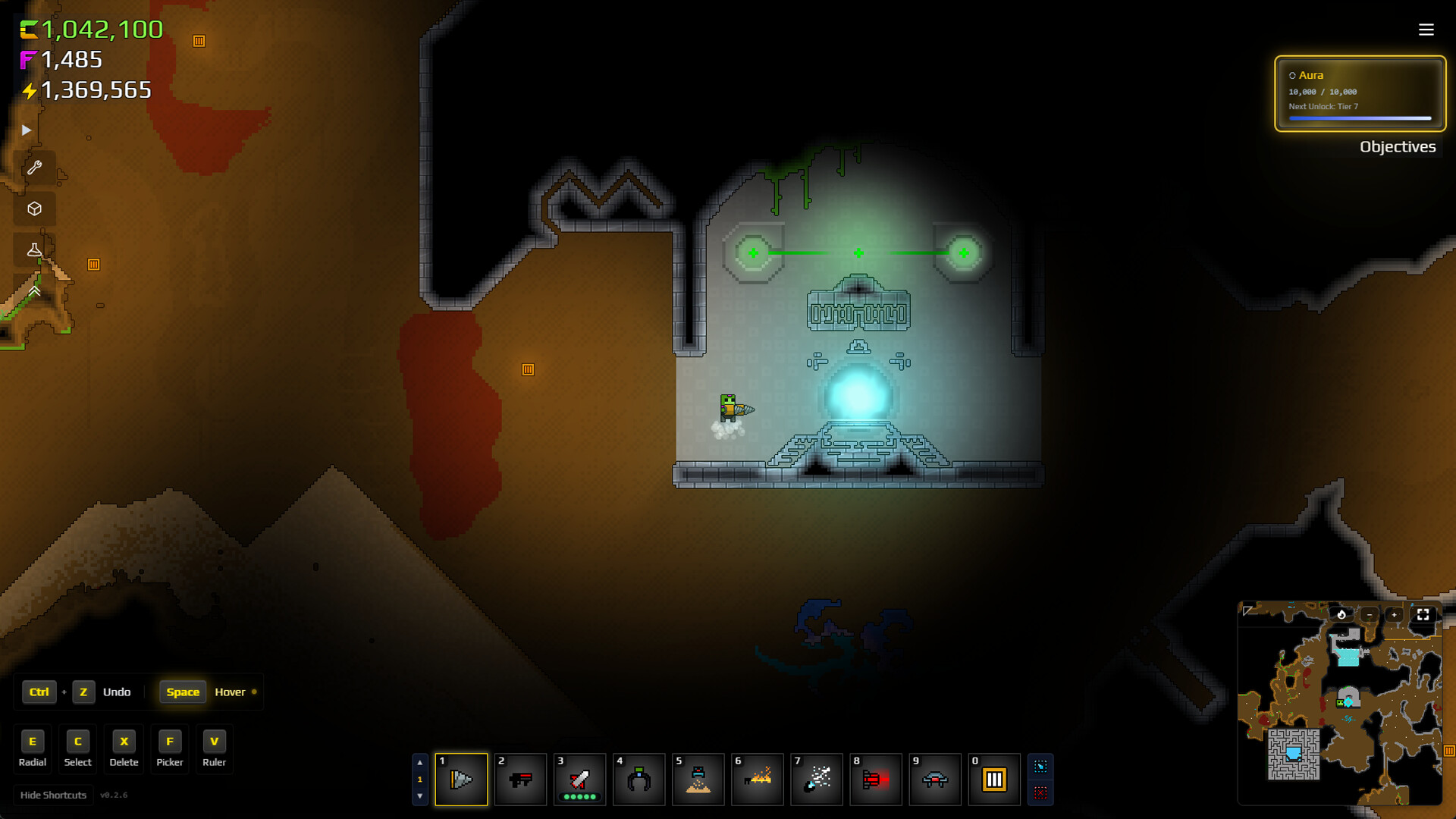
Lava occurs naturally deep underground in the Lava Cave. It is a liquid resource with freezing and Water interactions, so the safe factory design starts with containment.
Do not open a natural pocket until the receiving area and escape path are prepared.
The Cinder transport cycle
Snow from the Cryoblaster freezes Lava into Scoria. Breaking Scoria drops Cinders, which can travel on Conveyor Belts or Launchers. Igniting Cinder turns it back into Lava.
This cycle converts a dangerous liquid into a transportable solid and recreates the heat only where it is needed.
- Lava + Snow → Scoria.
- Break Scoria → Cinders.
- Transport Cinders.
- Ignite Cinders → Lava.
Automated burning with Filters
The official Lava page describes trapping Lava inside Filters so compatible pixels passing over it ignite. A Filter filled with Lava can burn Slag moved across the belt and turn it into Burnt Slag.
Build the Lava cell as a replaceable module. Keep unrelated burnable materials and Water out of the same transport path.
Update #3 and #4 behavior
The September 3 Update #3 raises Lava density to 200 and makes it destroy Fluxite, Redsoil and Strataform terrain. Recheck every containment wall before relying on an older layout.
When a Thermal Buffer is cold, Lava adds less heat and converts back to Cinder instead of being fully consumed. Update #4 (v0.5.7) then fixes Lava leaking through Advanced Filter Walls.
- Test with a small Cinder batch.
- Do not use Fluxite, Redsoil or Strataform as a Lava barrier.
- Advanced Filter Walls received a leak fix in v0.5.7.
- Do not expand an uncontained burner.
- Update #3 raises Lava density to 200.
- Lava now destroys Fluxite, Redsoil and Strataform terrain.
- Update #4 fixes Lava leaking through Advanced Filter Walls.
Version boundary: Updated for official v0.5.6 Lava behavior and the v0.5.7 Advanced Filter Wall leak fix; layout throughput remains version-sensitive.
Research behind this guide
This page was written from its own keyword material file. The sources below are not shared filler from another guide.
Lava Guide FAQ
Five practical answers covering setup, troubleshooting and version-sensitive decisions.
Where is Lava found in Sandustry?
Lava occurs in deeper underground areas such as the Lava Cave. Approach with a controlled excavation route and prepare containment before opening the final boundary, because the material can create heat and reaction hazards once released.
Can Lava be transported on conveyors?
Do not move liquid Lava as though it were an ordinary belt item. The documented workflow freezes Lava with Snow into Scoria, breaks Scoria into transportable Cinders, then reignites the Cinders inside containment at the destination.
What happens when Water touches Lava?
Water contacting Lava creates Steam according to the captured official material rules. Treat the meeting point as a designed reaction chamber; an accidental contact can consume resources or spread material into a part of the factory that was not built for it.
What tool freezes Lava?
The Cryoblaster is the relevant freezing tool. Confirm that you have the required research and enough working space before approaching the source; freezing is one step in the Scoria-to-Cinder transport chain, not a complete containment plan.
What changed for Lava in Sandustry v0.5.6?
Update #3 raises Lava density to 200, makes it destroy Fluxite, Redsoil and Strataform terrain, and changes cold Thermal Buffers so Lava adds less heat and returns to Cinder. Re-test old containment with a small batch before reconnecting valuable production.