 Sandustry Wiki
Factory Setup Guide
Design conveyors, filters and buffers that remain readable as output grows.
Researched 14 Sep 2026 · Official facts separated from community observationsControl falling pixels before chasing speed. Separate transport, processing and overflow so one jam cannot stop the whole chain. Update #4 (v0.5.7) fixes several unrelated causes of buildings stopping and propagating, but the developer warns that lingering cases may remain.
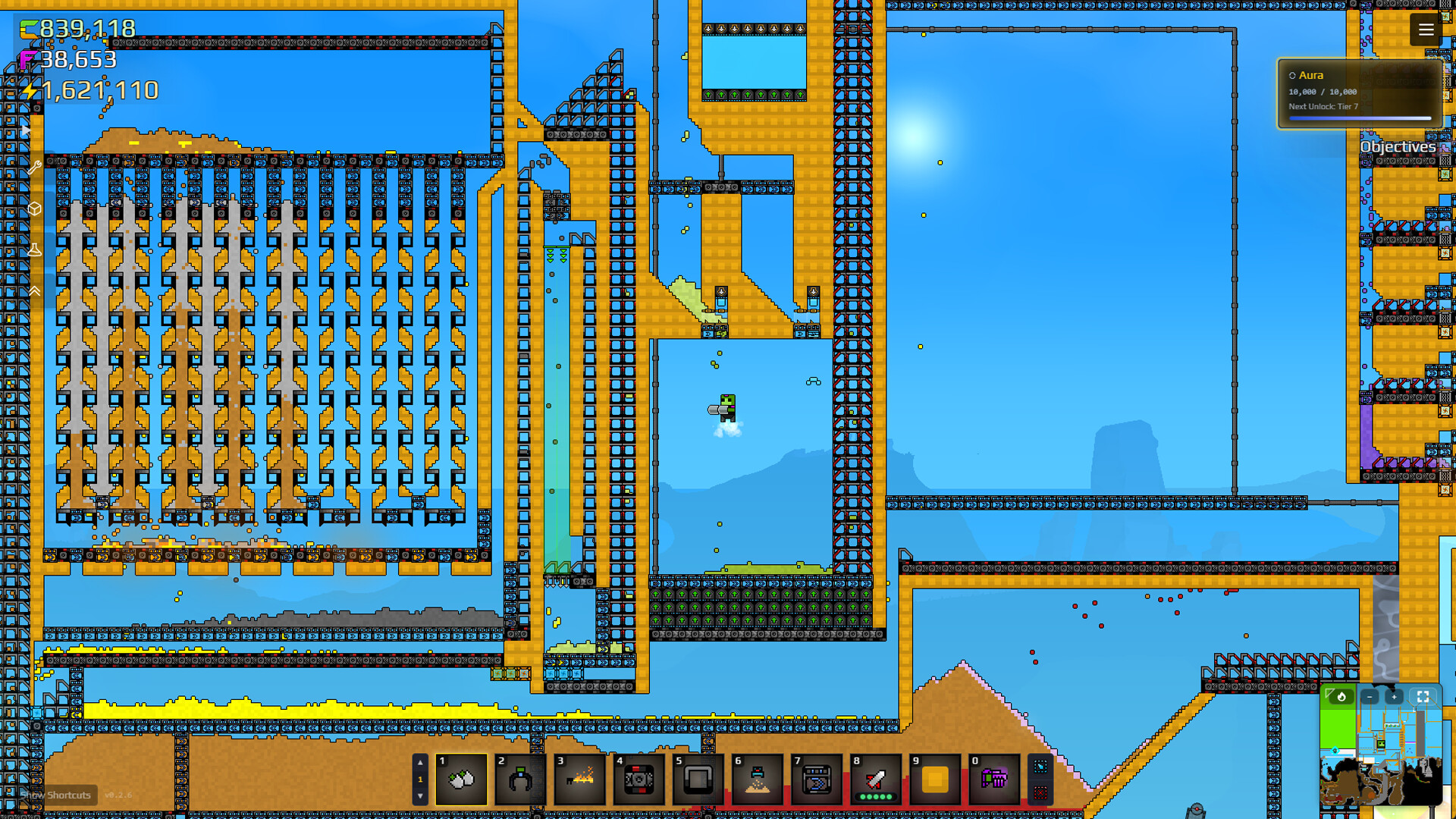
Design around material behavior
Sandustry factories move physical pixels, so a clean diagram is not enough. Every module needs walls, a controlled entry point and somewhere for excess material to wait.
Build transport and processing as separate layers. That makes it possible to stop one section without emptying the entire factory.
- Contain inputs before increasing throughput.
- Give byproducts their own path.
- Add a visible buffer before expensive processors.
Conveyors, launchers and filters
Conveyor Belts are the default horizontal transport. Launchers are useful when material must cross a gap or change elevation, but they add another place where pixels can escape.
Filters behave like conveyors while allowing configured materials to pass. Use them to split products from Slag or to protect a downstream machine from the wrong input.
- Test filter Allow/Block configuration with a small sample.
- Inspect corners where liquids may slip through.
- Keep the output path wider than the most variable stage.
Kinetic Slag Press layout
The press belongs after Slag has been prepared for its later processing stage. Feed it from a dedicated lane and preserve access for inspection.
The selected factory tutorials demonstrate multiple layouts. Their useful lesson is modularity: copy a proven module only after input, output and overflow all survive a full run.
Diagnosing a stopped factory
Start at the final output and work backward. A full output pocket can make every upstream machine appear broken.
Then check filters, mixed pixels and any liquid component. The Pump documentation shows how a solid pixel inside its pickup area can stop Water transport; the same visual-inspection habit applies across the factory.
- Output full? Clear or expand it.
- Wrong material? Recheck filter mode.
- Pixel escaped? Repair containment before restarting.
- One module works alone? Reconnect stages one at a time.
Update #4 building fixes
The September 14 Update #4 fixes several unrelated bugs that could make buildings stop working and spread the failure to connected systems. The developer says some errors may remain, so this is a patch boundary rather than a promise that every stalled factory is solved.
If a current v0.5.7 building still stops, record which module failed and whether reloading clears it before rebuilding the line. The same update also fixes pass-through Filters created from a Filter Wall and Conveyor Portals pairing incorrectly after Ctrl+H mirroring.
- Confirm the game is on v0.5.7.
- Test whether a reload restores the building.
- Check mirrored Conveyor Portal pairs.
- Report a reproducible lingering stop to the developer.
- Filters route selected materials.
- The Marquee can move or copy structures.
- Update #4 fixes several causes of buildings stopping and propagating; report whether reloading clears any remaining case.
Version boundary: Updated for official v0.5.7 building, Filter and Conveyor Portal fixes. Layout throughput and any lingering stoppage remain version-sensitive.
Research behind this guide
This page was written from its own keyword material file. The sources below are not shared filler from another guide.
Factory Setup Guide FAQ
Five practical answers covering setup, troubleshooting and version-sensitive decisions.
How do I stop a Sandustry conveyor line from jamming?
Trace one material at a time from input to final storage. Look for mixed pixels, a full output, insufficient containment and loose material falling into liquid infrastructure. Add a buffer or overflow route before increasing belt speed or duplicating the module.
What is the best way to organize a factory?
Separate transport, processing and overflow into readable modules. Give every input a contained entry, every process a serviceable working area, and every byproduct its own exit. This makes one failure visible and prevents it from stopping unrelated production.
When should I use Filters?
Use Filters where two or more materials share a transport path but require different destinations. Place them before a mixed stream reaches storage or another machine, then test every possible material rather than confirming only the preferred output.
How large should a buffer be?
A useful buffer absorbs normal variation without hiding a permanently blocked output. Begin with enough capacity for one complete cycle, observe where material accumulates, and enlarge it only when downstream processing is healthy but temporarily slower.
Can I copy a working module with the Marquee?
The Marquee can move or copy structures, but the copied geometry still depends on clear inputs, outputs and surrounding containment. Validate the original through a full cycle and inspect the destination area before treating copying as safe scaling.